
Table of Contents
- Understanding AC Compressor Replacement Cost in Eagle Rock, California
- Key Factors That Influence AC Compressor Costs
- Comparing Labor Rates, Refrigerant Recharge, and Installation Timeframes
- Repair or Replace: Making the Right Decision for Your Home
- Energy Efficiency, Standards, and Long‑Term Savings
- Frequently Asked Questions About AC Compressor Replacement
- Expert AC Compressor Replacement Guidance in Eagle Rock, California
Understanding AC Compressor Replacement Cost in Eagle Rock, California
Once a failing compressor is identified, understanding the ac compressor replacement cost in Eagle Rock, California helps commercial property owners plan ahead. For businesses in Eagle Rock and the surrounding areas, the cost of replacing a commercial AC compressor is typically higher than residential replacements due to larger unit capacities and greater refrigerant charges.
Multiple factors shape the cost of compressor replacement in commercial systems. HVAC labor rates per hour in Eagle Rock, California vary with job complexity, roof access, and permit needs. If a leak occurred, the ac refrigerant recharge cost adds a separate line item to the overall expense. Compressor type, warranty coverage, and AHRI performance ratings also influence pricing; high-efficiency units often cost more initially but can lower long-term operating expenses. In Eagle Rock’s hot summers, retail shops and offices need reliable cooling, so minimizing downtime is critical. Only licensed professionals should handle the replacement; Eagle Rock Prestige HVAC’s team brings local expertise and a decade of service to every job, so you can be confident in the work. We urge business owners to request a free, no-obligation estimate to understand their specific ac compressor replacement cost.
To get an accurate, no-obligation estimate for your commercial compressor replacement, reach out to our professional HVAC cooling services team. We’ll evaluate your system, discuss all cost variables, and deliver a straightforward quote.
Key Factors That Influence AC Compressor Costs
When a commercial HVAC system in Eagle Rock fails, the ac compressor replacement cost quickly becomes a pressing concern for facility managers. Several key factors—from compressor technology and brand selection to labor rates and refrigerant needs—determine the final price. Knowing how each variable affects overall cost allows for more informed decisions when comparing quotes.
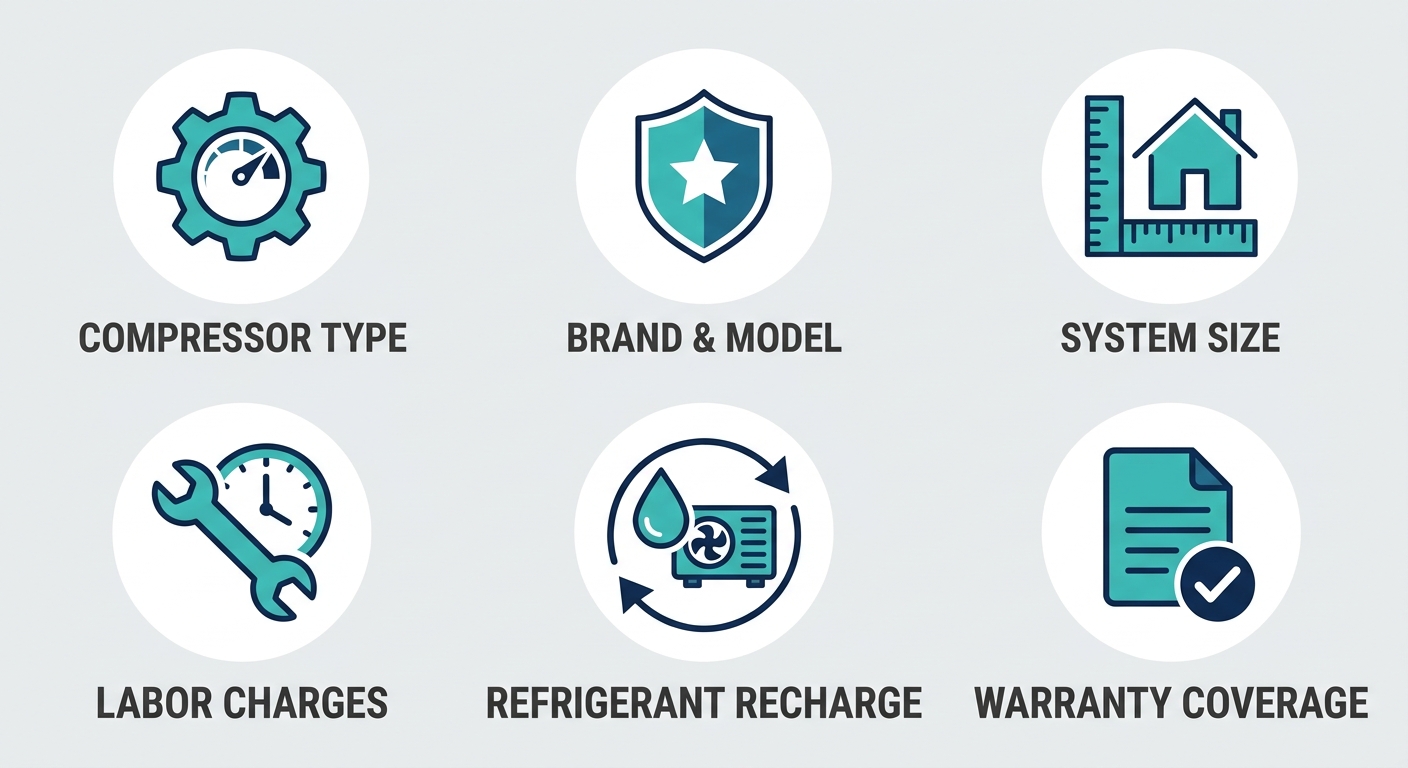
The following six factors shape any AC compressor replacement estimate in the Eagle Rock area. Compressor type sets the baseline—single-stage units are most affordable, while variable-speed compressors add 30–50% to the unit price but deliver higher efficiency. Premium brands like Carrier and Trane cost 20–35% more than standard options, typically offering longer warranties. System size (tonnage) increases compressor expense by 15–25% per added ton, along with more labor and refrigerant. Labor charges account for 40–60% of the total; commercial hvac labor rates per hour can be elevated due to complexity. Refrigerant recharge adds $100–$300 on average, and the ac refrigerant recharge cost escalates if leaks must be repaired. Warranty coverage reduces out-of-pocket costs by covering the compressor unit, with extended plans sometimes including labor.
The table below details the primary cost drivers and their typical impacts:
| Factor | Description | Typical Impact on Cost |
|---|---|---|
| Compressor Type | Single-stage, two-stage, or variable-speed compressor | Single-stage is most affordable; variable-speed adds 30–50% to compressor cost |
| Brand & Model | Manufacturer and specific compressor series | Premium brands can add 20–35% compared to standard options |
| System Size (Tonnage) | Cooling capacity in tons (e.g., 3-ton, 5-ton) | Larger compressors cost 15–25% more per additional ton |
| Labor & Service Charges | Hourly HVAC labor rates and installation complexity | Can constitute 40–60% of the total replacement price |
| Refrigerant Recharge | Amount of R-410A or R-32 refrigerant needed | Adds $100–$300 on average, depending on system charge |
| Warranty Coverage | Manufacturer back-to-back warranty and extended plans | Can reduce out-of-pocket cost by covering compressor unit itself |
Putting these factors together, a larger commercial system with a premium variable-speed compressor will command a higher initial investment, but the long-term energy savings and reliability often justify the expense. Labor rates and refrigerant volumes grow with system size, so facility managers should compare total cost of ownership rather than just the compressor price. AHRI performance data confirms that higher-efficiency variable-speed compressors justify their initial premium through energy savings over time. As Eagle Rock Prestige HVAC’s refrigerant leak detection guide notes, undetected leaks can escalate refrigerant recharge costs and hasten compressor failure, so prompt diagnosis is critical. Following routine air conditioner maintenance tips can help extend compressor life and reduce the frequency of replacements, thereby lowering long-term costs.
The infographic below provides a visual summary of the six cost factors.
Understanding these key drivers demystifies the ac compressor replacement cost and prepares you for the strategies discussed in the next section.
Comparing Labor Rates, Refrigerant Recharge, and Installation Timeframes
When your AC compressor fails, the total AC compressor replacement cost depends on more than just the price of the part. Labor rates, refrigerant recharge fees, and the time required for installation all contribute to your final bill. Eagle Rock homeowners can use regional cost data to budget accurately for this essential repair.
The following table compares labor, refrigerant, and installation time costs across national averages, California ranges, and typical figures for Eagle Rock:
| Service | National Average | California Range | Eagle Rock Typical |
|---|---|---|---|
| Compressor replacement labor | $500–$1,200 | $600–$1,500 | $650–$1,400 |
| Refrigerant recharge (R-410A per lb) | $100–$200 | $120–$250 | $130–$240 |
| Total installation time (hours) | 4–8 | 4–8 | 4–7 |
| Typical 5-ton compressor only (part) | $1,200–$2,500 | $1,400–$2,800 | $1,500–$2,700 |
California energy codes, which align with ASHRAE (American Society of Heating, Refrigerating and Air-Conditioning Engineers) standards, often require stricter refrigerant handling and longer system testing. These regulations can slightly extend installation times and push labor costs to the higher end of the ranges shown above, especially in the Eagle Rock market where local operating expenses are already elevated.
Hourly Labor Rates for HVAC Services
Eagle Rock HVAC labor rates per hour generally exceed national benchmarks. While the nationwide average for compressor replacement labor sits at $500–$1,200, our area typically sees $650–$1,400 for the same job. This difference primarily stems from Southern California’s higher cost of living, which drives up technician wages and insurance costs. In addition, California requires HVAC contractors to hold a state-issued C-20 license and maintain current certifications, a factor that contributes to elevated service rates.
For a full compressor swap, the labor portion includes diagnosis time, system evacuation, refrigerant recovery, soldering of copper lines, and post-installation testing. When you break down those tasks into an hourly rate, local HVAC professionals commonly fall between $100 and $160 per hour. Complex installations or systems in difficult-to-access locations can push the total labor cost toward the upper end of that range.
AC Refrigerant Recharge Costs After Compressor Failure
After a compressor failure, a complete refrigerant recharge is almost always necessary. The discharged refrigerant must be recovered, the system evacuated, and new R-410A refrigerant charged to the manufacturer’s specification. In Eagle Rock, the AC refrigerant recharge cost typically ranges from $130 to $240 per pound, reflecting ongoing R-410A supply constraints and regional pricing trends.
The total recharge bill can increase significantly if a refrigerant leak contributed to the original compressor failure. Leaks force the system to run longer and harder, and repairing them requires additional labor and materials. Our guide on six methods for detecting HVAC refrigerant leaks explains how even small, hard-to-find leaks add to the overall expense—addressing these issues at the time of compressor replacement helps prevent future breakdowns and repeat recharge costs.
Compressor Installation Timeframes: From Diagnosis to Completion
Most compressor installations in Eagle Rock are completed within 4 to 7 hours, with the full AC compressor replacement cost reflecting that labor window. The process begins with a diagnostic visit, which usually takes an hour, and then moves to component removal, system flushing, installation of the new compressor, and a thorough post-installation check.
Several factors can stretch the timeline. Tight attic spaces or rooftop access can slow work, and refrigerant line modifications—often required when switching to a new compressor type—add time as well. Additional repairs, such as replacing a damaged condenser coil or sealing leaky ductwork, can extend the job to a full day. Communicating with your technician about the system’s condition upfront helps set realistic expectations for both the schedule and the final estimate.
Understanding these regional differences helps you secure a fair estimate. For more details on keeping your system efficient, continue reading. For additional ways to extend your system’s lifespan, see our fall air conditioner preparation tips.
Repair or Replace: Making the Right Decision for Your Home
When your air conditioner starts showing signs of trouble, the next critical step is deciding whether to invest in repairs or replace the entire unit. For homeowners and business owners in Eagle Rock, making the right choice involves analyzing your system’s age, repair costs, and future energy efficiency. This section walks you through a practical decision framework tailored to our local climate and energy standards.
Assessing Your AC Unit’s Age and Condition
Chronological age is the first factor to consider. Eagle Rock Prestige HVAC’s experience in the field indicates that once an air conditioner surpasses the 12-year mark, the frequency and cost of repairs tend to rise sharply. Systems of this age often operate at a SEER rating well below today’s minimum 14 SEER standard, resulting in higher monthly energy bills. ASHRAE guidelines recommend evaluating lifecycle costs when the repair estimate approaches 30% of a new system’s price — a threshold many aging units in our area exceed.
Even units that have been well-maintained cannot escape the effects of component wear. The compressor, condenser coil, and evaporator coil degrade over time, and while regular tune-ups can extend life by two to three years, the financial equation inevitably shifts. Our technicians frequently find that a 12-year-old system showing multiple failure symptoms is better served by a full replacement than by a series of piecemeal fixes. This reality is particularly relevant in Eagle Rock, where summer heat waves push equipment to its limits.
The Cost-Benefit Analysis of Repair vs. Replacement
Making a data-driven decision requires weighing the immediate repair expense against the long-term investment of a new system. A simple but effective tool is the $5,000 rule: multiply the age of your unit (in years) by the cost of the repair. If the product exceeds $5,000, replacement is the financially prudent path. For example, a 10-year-old residential AC needing a $600 compressor repair yields $6,000, clearly tipping the scale toward installation of a new 16-SEER unit.
Consider a more nuanced case from Eagle Rock: a 9-year-old system requires a $450 repair. That’s $4,050 under the $5,000 rule, so repair might seem acceptable. However, pairing the repair with a planned upgrade within two years could be the smarter move, especially when you factor in the hvac labor rates per hour in Eagle Rock, which range from $80 to $150, and the rising ac refrigerant recharge cost for units that rely on R-22. For commercial properties, the numbers escalate quickly — ac compressor replacement costs in commercial settings often land between $2,500 and $5,000, meaning the $5,000 rule may be triggered even earlier.
To simplify your evaluation, refer to the decision matrix below.
| Factor | Repair Option | Replace Option | Recommendation |
|---|---|---|---|
| Unit Age | Extend life 2–3 years | Start with 10-15 year lifespan | Replace if >12 years old |
| Repair Cost vs. New System Cost | Upfront saving if <50% of new unit | Higher initial investment | Apply the $5,000 rule: repair × age > $5,000 → replace |
| Current SEER Rating | Stays same | Jump to 16+ SEER | Replace if current SEER is <14 for long-term savings |
| Warranty Status | May cover part cost | Full new warranty included | Replace if compressor part only warranty, no labor coverage |
| Refrigerant Type | Keep using R-410A if compliant | Transition to R-32 ready unit | Replace if system uses phased-out R-22 |
Data validated by the AHRI HVAC trade association product directory.
Applying this matrix to a common Eagle Rock scenario — a 10-year-old R-22 unit needing a $600 repair — highlights that three of the five criteria strongly favor replacement. While the upfront cost of a new system is higher, the long-term savings and improved performance make the investment worthwhile.
Beyond the immediate financial comparison, the efficiency upgrades you gain with a new unit deliver ongoing benefits that are hard to ignore.
Considering Energy Efficiency Upgrades
The 2025 Department of Energy minimum SEER standard for the Southwest region, including California, is 14. In contrast, replacement units routinely achieve 16 SEER or higher, thanks to advanced compressor technology and improved coil designs. The AHRI HVAC trade association certifies these SEER ratings, giving homeowners confidence that published efficiency numbers are verified independently and match real-world performance.
In Eagle Rock, moving from an old 10-SEER unit to a 16-SEER model can significantly reduce cooling costs during the long warm season. Local utility rebates may further offset the higher upfront investment, making the upgrade more accessible. ASHRAE performance guidelines confirm that higher SEER equipment not only lowers energy consumption but also improves humidity control and indoor comfort — benefits that add value to both residential and commercial properties. A thorough analysis of your current system’s efficiency, paired with AHRI-verified specifications, provides a clear picture of the payback period for your next AC.
For a personalized assessment of your AC unit and a no-obligation estimate, contact Eagle Rock Prestige HVAC to discuss your options.
Energy Efficiency, Standards, and Long-Term Savings
After considering replacement costs, it is equally important to evaluate energy efficiency. While ac compressor replacement cost in Eagle Rock can be a worry for business owners, upgrading to a higher SEER unit reduces long-term expenses. SEER, or Seasonal Energy Efficiency Ratio, indicates cooling efficiency — higher ratings mean lower energy use. AHRI certifies SEER ratings under controlled testing conditions, and the ASHRAE HVAC engineering society sets benchmark guidelines such as ASHRAE 90.1. ISO standards like ISO 5151 add global comparability.
The following table shows how upgrading from a lower SEER to a more efficient model translates into annual savings and a payback period.
| Current SEER | New SEER | Annual Savings (approx.) | Payback Period (years) |
|---|---|---|---|
| 10 | 16 | $180–$250 | 6–8 |
| 13 | 18 | $130–$200 | 7–10 |
| 14 | 20 | $100–$180 | 8–12 |
For example, moving from SEER 10 to SEER 16 can cut annual cooling costs by approximately $180 to $250, with a payback period of 6 to 8 years. While the initial outlay may include hvac labor rates per hour and new equipment, the cumulative savings over a 15- to 20-year lifespan often offset the ac compressor replacement cost. A lower-efficiency unit can also lead to greater ac refrigerant recharge cost over time, as older systems tend to need more frequent refrigerant service.
For commercial properties in Eagle Rock, selecting a high-SEER compressor directly lowers operating expenses and improves profit margins. ASHRAE 90.1 compliance often requires a minimum SEER, but exceeding that baseline can deliver meaningful energy savings each year. With typical commercial rooftop units running hundreds of hours annually, even a modest SEER improvement reduces electricity bills significantly — and the payback period shortens as energy rates rise. Beyond direct utility savings, higher-efficiency equipment tends to have longer service intervals and fewer unexpected repairs, lowering total cost of ownership. Factoring in reduced ac refrigerant recharge cost and potential rebates for energy-efficient upgrades further strengthens the business case. By investing in a system with an appropriate SEER rating, facility managers lock in predictable energy costs, extend equipment life, and ensure reliable cooling — a forward-looking choice that keeps future service needs simple.
Frequently Asked Questions About AC Compressor Replacement
Still have questions? Here are the most common ones.
What factors influence AC compressor replacement cost? Several factors determine AC compressor replacement cost in Eagle Rock, including compressor size, refrigerant type, and local labor rates.
What are the signs my AC compressor is failing? Common signs include no cool air, strange noises, and unusual smells, as described in our blog on air conditioning odors.
Are HVAC labor rates per hour included in the replacement? Yes, HVAC labor rates per hour in Eagle Rock are part of your estimate and vary based on job complexity.
Do I need an AC refrigerant recharge with compressor replacement, and what standards apply? An AC refrigerant recharge cost may apply if refrigerant levels are low, and we follow codes from IAPMO and the ISO international standards organization for installation quality.
Contact us for a free estimate. ISO is a registered trademark of the International Organization for Standardization.
Expert AC Compressor Replacement Guidance in Eagle Rock, California
Understanding ac compressor replacement cost in Eagle Rock begins with professional diagnosis by a licensed HVAC technician.
When a compressor fails in Eagle Rock’s hot summers, prompt attention is critical. Key cost drivers include equipment quality, local hvac labor rates per hour, and any needed ac refrigerant recharge cost. We recommend obtaining a written estimate that itemizes all labor, refrigerant, and disposal fees. As a full-service Eagle Rock contractor with over a decade of experience, we provide professional AC compressor replacement.
Contact us for a personalized quote that reflects your system’s exact needs.