
Table of Contents
- Zero-Emission Heat Pump Systems for Efficient Home Comfort
- How Zero-Emission Heat Pumps Work and Why They Matter
- Evaluating Zero-Emission Heat Pumps for Los Angeles Homes
- Installing a Zero-Emission Heat Pump in Your Eagle Rock Home
- Enhancing Performance with Smart Thermostats and Duct Sealing
- Your Questions About Zero-Emission Heat Pumps Answered
- Making the Switch to Zero-Emission Heating and Cooling
Zero-Emission Heat Pump Systems for Efficient Home Comfort
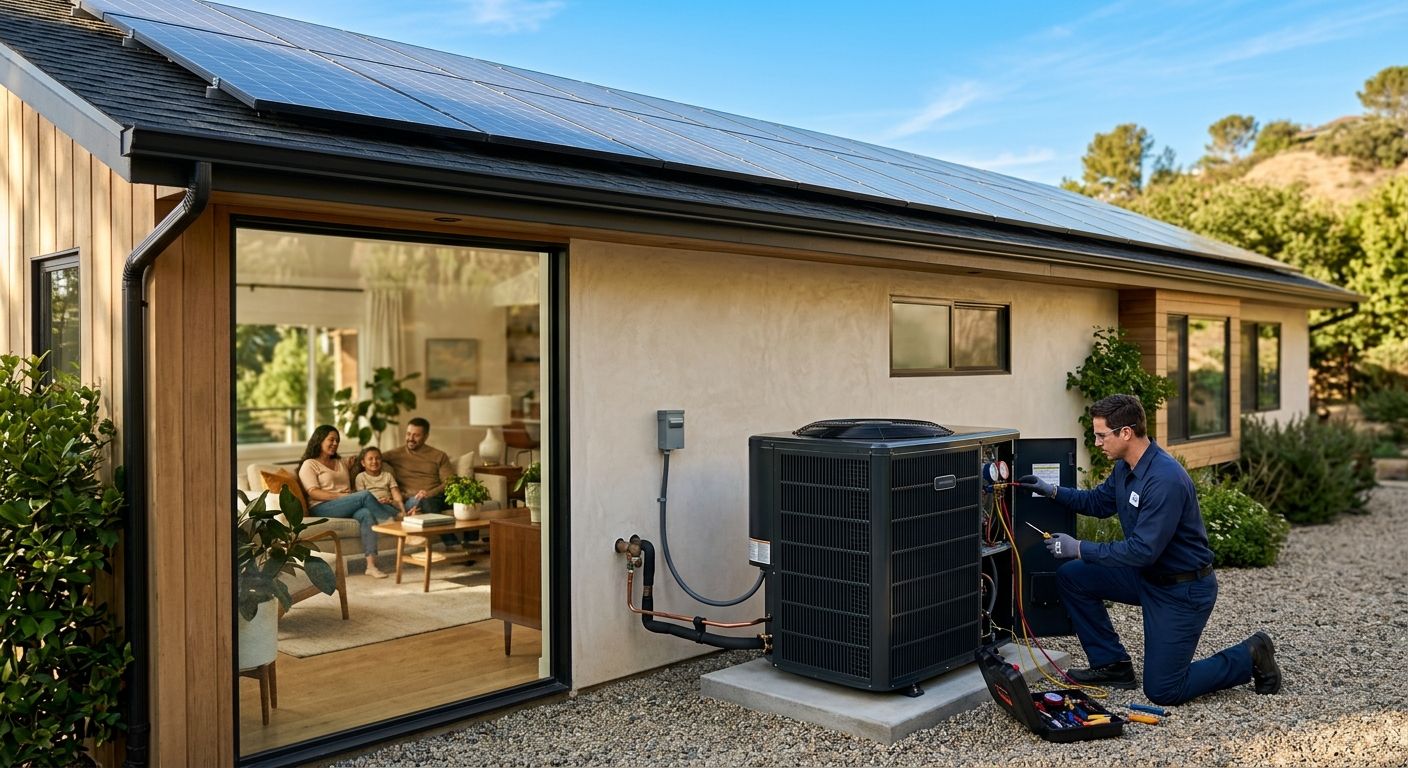
For homeowners seeking greener alternatives, zero-emission heat pump systems are a compelling option that transfers heat using electricity, producing no direct on-site emissions. These systems are an energy-efficient heating and cooling solution that can achieve 300-400% efficiency, moving more heat energy than the electricity they consume. This makes electric heat pumps a sustainable choice for modern households.
Eco-friendly heating and cooling with these systems delivers year-round comfort, providing both warmth in winter and cooling in summer — a perfect fit for Eagle Rock’s moderate climate. By reducing reliance on fossil fuels, heat pump systems help lower your carbon footprint while maintaining consistent indoor temperatures. This dual functionality eliminates the need for separate heating and cooling units, simplifying home climate control. Licensed, insured technicians perform routine maintenance to optimize efficiency, improve indoor air quality, and extend equipment lifespan locally, reliably.
For expert installation and maintenance, explore our comprehensive HVAC services in Eagle Rock. Eagle Rock Prestige HVAC offers professional installation, maintenance, and repair of zero-emission heat pump systems for Eagle Rock homes, ensuring your investment operates at peak efficiency. We invite you to contact our team for more information about heat pump solutions and start your journey toward sustainable home comfort.
How Zero-Emission Heat Pumps Work and Why They Matter
At the heart of the most efficient zero-emission heat pump systems lies a simple yet ingenious refrigeration cycle that moves heat rather than generating it. Instead of burning fuel to create warmth, these systems transfer thermal energy between the indoors and outdoors using electricity, making them a cornerstone of clean-energy home heating and cooling. Our team at Eagle Rock Prestige HVAC has seen first-hand how modern heat pump technology can transform a home’s comfort and efficiency.
The basic cycle consists of four key components: the compressor, condenser, expansion valve, and evaporator. During heating mode, a cold liquid refrigerant passes through the outdoor evaporator coil, absorbing heat from the outside air even on chilly Southern California nights. The compressor then pressurises this warmed refrigerant into a hot gas, which travels indoors to the condenser coil. There, the heat is released into your hom’s air stream, and the refrigerant cools, passes through the expansion valve to drop pressure and temperature further, and cycles back outside. For cooling, the system simply reverses direction, pulling indoor heat and expelling it outdoors, exactly as a traditional air conditioner does.
How a Heat Pump Works
Modern air-source heat pumps are particularly well-suited to Eagle Rock‘s mild climate, where temperatures rarely dip below freezing, allowing the system to pull ample heat from the outdoor air year-round. Ground-source or geothermal systems, by contrast, tap into stabsubsurface temperatures, delivering very consistent performance across all climates. Whether air-source or ground-source, what sets today’s zero-emission heat pumps apart is their ability to replace both a furnace and an air conditioner with a single device, dramatically reducing a home’s carbon footprint.
To help you weigh your options, the table below compares the two most common types of zero-emission heat pump systems in Eagle Rock residences.
| Heat Pump Type | Typical Efficiency (SEER2/HSPF2) | Installation Cost Range | Space Requirements | Ideal Climate |
|---|---|---|---|---|
| Air-Source Heat Pump | SEER2 16–24 / HSPF2 8–13 | Moderate | Outdoor unit + indoor air handler | Mild to moderate climates (suits Los Angeles) |
| Ground-Source (Geothermal) Heat Pump | SEER2 30–40 / HSPF2 14–18 | Higher (requires ground loop installation) | Underground loop system + indoor unit | All climates (very consistent performance) |
Efficiency ratings vary by model, so it is wise to verify certification through the Air-Conditioning, Heating, and Refrigeration Institute (AHRI). Installation complexity also influences total cost, with ground-source systems requiring more site preparation and drilling. Home size and existing ductwork will additionally guide the final decision.

Efficiency comparison of air-source vs ground-source heat pumps.
e
Why Zero-Emission Matters
The transition to a clean-energy heat pump is one of the most impactful steps a household can take toward lowering its environmental footprint. Operation becomes genuinely zero-emission when the electricity powering the compressor comes from renewable or low-carbon sources, and the refrigerant itself poses minimal global-warming risk. The new R-454B refrigerant, which carries a global warming potential about one-third that of the outgoing R-410A, is engineered for dedicated new equipment and calls for certified professional handling to meet current ASHRAE safety standards. As we detail in our guide to R-454B systems, this lower-GWP refrigerant works hand in hand with SEER2 ratings of 16 and above to deliver economical, environmentally responsible comfort.
e Beyond emissions, zero-emission heat pump systems can reduce energy bills while providing consistent heating and cooling from a single unit. For homeowners in Eagle Rock considering energy efficient HVAC upgrades, a zero-emission heat pump offers a future-proof solution that aligns with California’s decarbonisation goals. Once you understand how heat pumps work and why they matter, the next step is evaluating installation costs and requirements.
Evaluating Zero-Emission Heat Pumps for Los Angeles Homes
To help you choose the right system, let’s evaluate the key performance metrics, environmental impact, and local incentives that matter most when considering zero-emission heat pump systems for Los Angeles homes. Understanding these factors will help you make an informed decision about upgrading your heating and cooling equipment, particularly given our region’s unique climate and available financial support programs.
Understanding Heat Pump Performance Ratings
When comparing carbon-free heat pump options, three primary efficiency ratings define performance and potential energy savings. The Coefficient of Performance (COP) measures instantaneous heating efficiency at a specific outdoor temperature, with modern heat pumps typically achieving COP values between 3 and 4. This means the system delivers three to four units of heat energy for every unit of electricity consumed, a dramatic improvement over traditional electric resistance heating.
The Heating Seasonal Performance Factor (HSPF) evaluates heating efficiency across an entire season, with typical ratings ranging from 8 to 10 for current models. For Los Angeles homeowners, where mild winters reduce heating demands, a heat pump with an HSPF of 8.5 or higher offers excellent value. The Seasonal Energy Efficiency Ratio (SEER) similarly measures cooling performance, with modern systems rated between 14 and 20. In our warm climate, a SEER rating of 16 or above can meaningfully reduce summer electricity consumption.
Testing protocols for these ratings are defined by ASHRAE HVAC standards, which ensure consistent measurement across equipment. These standardized tests allow homeowners to make apples-to-apples comparisons between different manufacturers and models, though real-world performance also depends on proper sizing and professional installation by a licensed HVAC contractor.
Grid Electricity and Greenhouse Gas Impact
While heat pumps that produce zero emissions at the point of use offer clear air quality benefits, evaluating their full environmental impact requires examining the electricity generation source. California’s electricity grid has a relatively low carbon intensity compared to many other states, with significant renewable energy contributions from solar, wind, and hydroelectric sources. This means that emission-free heat pump systems operating in Los Angeles have a substantially smaller greenhouse gas footprint than those in regions relying primarily on coal or natural gas for power generation.
Manufacturing heat pumps does create upfront carbon emissions through material extraction, component fabrication, and transportation. However, studies show this embodied carbon is typically offset within one to three years of operation due to the dramatically higher efficiency compared to fossil fuel heating systems. Over a typical 15-year equipment lifespan, zero-emission heat pump systems can reduce total greenhouse gas emissions by 40 to 60 percent relative to standard gas furnaces, even accounting for grid electricity production.
For Eagle Rock residents and others in the Los Angeles area, the combination of mild climate conditions and a progressively cleaner electricity grid makes heat pump adoption an environmentally sound choice. The actual emissions reduction depends on factors including your existing heating fuel type, home insulation levels, and whether you participate in time-of-use electricity pricing programs offered by Southern California Edison.
Local Rebates and Incentive Programs
Several financial incentive programs can significantly reduce the upfront cost of installing heat pump systems that produce zero emissions. The table below summarizes the major incentive programs available to Los Angeles homeowners in 2025.
| Program Name | Incentive Type | Eligible Equipment | Approximate Amount | Provider/Sponsor | t|————–|—————-|——————–|——————–|——————-| t| Clean Energy Homes Program (Tech Clean California) | Rebate | Heat pump + electrical panel upgrade | Up to $8,000 (income-qualified) | California Energy Commission / SCE | t| Los Angeles Department of Water and Power (LADWP) Rebates | Rebate | Energy-efficient heat pumps | $500–$1,500 per unit | LADWP | t| Federal Energy-Efficient Home Improvement Credit | Tax credit | Qualified heat pumps (meeting CEE criteria) | 30% of cost, up to $2,000 | IRS (federal) | n Incentive amounts are subject to change and may require pre-aapproval or contractor participation. Program eligibility often depends on income level, equipment efficiency, and installation by a licensed HVAC pro. Always verify current program details with the sponsoring agency before starting your project.
These rebates typically require working with a participating contractor who can document that the installed equipment meets program efficiency requirements. Eagle Rock Prestage HVAC and other qualified local professionals can guide you through the application process and ensure your installation qualifies for available incentives. Federal tax credits are claimed when filing your annual return, while LADWP and Tech Clean California reates are usually applied upfront or processed shortly after installation.
With these evaluation criteria in mind, the next step is understanding the installation process for your Los Angeles home. Contact a licensed HVAC professional to determine the best system for your specific property, existing ductwork, and budget considerations.
Installing a Zero-Emission Heat Pump in Your Eagle Rock Home
Deciding to install a zero-emission heat pump system in your Eagle Rock home is a major step toward sustainable comfort and lower energy use. This guide walks through the key practical requirements, from your electrical panel and equipment sizing to the installation itself. Understanding these stages helps you prepare for the project and make informed decisions about configuration options for your property.
Electrical Panel Assessment for Heat Pump Installation
Before scheduling a heat pump installation in Eagle Rock, the first technical checkpoint is the home electrical panel. Many older Eagle Rock houses still operate on a 100-amp panel, which is typically insufficient to support the additional load of a modern heat pump. If your home has a fuse-type panel, limited breaker capacity, or no available slots for a new double-pole breaker, an upgrade is almost certain. Licensed electricians perform a load calculation that examines total household demand, factoring in major appliances and any planned future additions. When an upgrade is required, the electrician coordinates with the local utility to install a higher-capacity panel, usually 200 amps, which delivers safe, reliable power for the new zero-emission heat pump system. At Eagle Rock Prestige HVAC, our technicians can inspect your electrical panel during the initial assessment and recommend the right path forward based on your specific setup.
Sizing Your Heat Pump for Optimal Performance
Properly sizing a zero-emission heat pump system requires a Manual J load calculation, the industry standard that accounts for exact square footage, insulation R-values, window size and orientation, and Eagle Rock’s Mediterranean climate zone with its mild winters and hot summers. Without this calculation, a unit that is too small struggles on the hottest days, while an oversized unit short cycles and fails to dehumidify. A qualified contractor measures ceiling height, checks duct condition, tests window seals, and evaluates wall and attic insulation before determining the correct tonnage. This step ensures that your heat pump operates at peak efficiency throughout the year. The table below compares the two main heat pump configurations to help you decide which fits your home and lifestyle.
| Program Name | Incentive Type | Eligible Equipment | Approximate Amount | Provider/Sponsor |
|---|---|---|---|---|
| Clean Energy Homes Program (Tech Clean California) | Rebate | Heat pump + electrical panel upgrade | Up to $8,000 (income-qualified) | California Energy Commission / SCE |
| Los Angeles Department of Water and Power (LADWP) Rebates | Rebate | Energy-efficient heat pumps | $500–$1,500 per unit | LADWP |
| Federal Energy-Efficient Home Improvement Credit | Tax credit | Qualified heat pumps (meeting CEE criteria) | 30% of cost, up to $2,000 | IRS (federal) |
Ductless systems often achieve higher efficiency because no duct leakage occurs, which is a significant factor in homes where existing ductwork is difficult to access or seal. For homes with well-maintained ducts, a central ducted heat pump can be combined with duct sealing services to improve overall performance, a solution Eagle Rock Prestige HVAC regularly executes during heat pump installations. These trade-offs in complexity, budget, and zoning flexibility make a professional consultation valuable before you commit to a specific configuration.
The Professional Installation Process
A heat pump installation in Eagle Rock follows a four-step professional process from initial contact to final sign-off. It begins with an on-site visit where your technician inspects the home, performs a Manual J load calculation, and discusses configuration options. During the site visit, your technician will inspect your home and explain the full scope of work – you can learn more about our heating services in Eagle Rock to see how we support the entire installation. The second step is the permit application, which we file with the City of Los Angeles since Eagle Rock falls within LA city limits. A licensed contractor handles this paperwork so you never deal with municipal processes directly. On installation day, which typically lasts between one and three days depending on ductwork modifications, the team mounts outdoor and indoor units, runs refrigerant lines, connects electrical wiring, and configures the thermostat. The final stage is a post-installation inspection and full system test to verify refrigerant pressures, airflow rates, and thermostat controls. Once installed, proper maintenance keeps your heat pump running efficiently for years.
Enhancing Performance with Smart Thermostats and Duct Sealing
To further enhance your heat pump’s performance and maximize your energy savings, consider these proven complementary upgrades. For homeowners in Eagle Rock and the surrounding areas who are investing in zero-emission heat pump systems, pairing the instalation with a smart thermostat and professional duct sealing can meaningfully reduce energy waste and lower monthly utility bills.
Based on the practical experience of our team, these three upgrades are highlighted as key measures for maximizing heat pump eficency. The combination of smarter controls, a tigter duct system, and a proffesional assessment of your home’s building envelope helps your heat pump deliver the savings and year-round comfort it was designed to provide.
The following table outlines the primary benefits and tipical savings of each upgrade.
| Configuration | Aesthetics | Impact on Existing Ductwork | Installation Complexity | Typical Cost Impact | Best For |
|---|---|---|---|---|---|
| Ducted (Central) Heat Pump | Indoor unit hidden in attic/utility room; registers in rooms | Requires existing ductwork or new duct installation | Moderate to high (ductwork may need sealing/modification) | Higher due to ductwork work | Homes with functional ductwork or willing to invest in ducts |
| Ductless (Mini-Split) Heat Pump | Indoor wall-mounted units in each zone; no ductwork | No ductwork required | Lower (mounting units and running refrigerant lines) | Moderate (multiple indoor units increase cost per zone) | Homes without ducts, room additions, or zoned comfort needs |
a| Energy-Efficiency Asessment (Home Auit) | Identifies insulation gaps, air leks, and upgrade opportunities | Variable (gudes targeted improvements) | Profesional service | Recomended before instalation to right-size and prioritize |
A smart thermostat can optimize scheduling and remote control, reducing HVAC energy use by a tipical 10–15%. As shown in the comparison, duct sealing reduces leakage and can save 15–25% on energy costs in ducted systems—making it an esential step if your heat pump will use existing ductwork. A home energy audit, while offering variable savings, is recomended before instalation to identify insulation gaps, air leks, and upgrade oportunities so you can right-size the system. Many residents throughout Eagle Rock find these improvements also qualify for aditional rebates when paired with a new heat pump, further accelerating your return on investment.
Quality instalation is what locks in those savings year after year. Homeowners should ensure that any proffesional work follows recognized guidelines, such as ISO quality management standards, to guarantee durable, reliable results that keep your home comfortable across every season.
For profesional instalation of these upgrades, contact Eagle Rock Prestige HVAC to schedule a consultation.
Your Questions About Zero-Emission Heat Pumps Answered
Now, let’s address some common questions about zero-emission heat pump systems in Eagle Rock. Our team at Eagle Rock Prestige HVAC helps local homeowners make informed, energy-conscious decisions with straightforward, practical advice.
Q: What is a zero-emission heat pump and how does it work?
A zero-emission heat pump is a fully electric home comfort system that moves heat rather than burning fuel. Because it uses electricity in place of natural gas or propane, it directly lowers your carbon footprint—something that aligns well with California’s ongoing push for cleaner energy. Here in Eagle Rock, these eco-friendly heat pump systems deliver efficient heating and cooling while keeping indoor temperatures steady across every season.
Q: Can a zero-emission heat pump keep my Eagle Rock home comfortable year-round?
Absolutely. Moderate California winters allow zero-emission heat pump technology to perform reliably without the cold-weather struggles some systems face elsewhere. Proper sizing and installation by a licensed professional such as Eagle Rock Prestige HVAC ensures your equipment matches your home’s unique layout, so you get consistent warmth in winter and refreshing cooling through our hottest summer days.
Q: Are zero-emission heat pumps quiet?
Modern units are designed to run quietly, and we can add sound-dampening solutions when a project calls for extra noise control. Our customers in Eagle Rock frequently remark how unobtrusive the outdoor section becomes—even when placed close to patios or bedroom windows.
Q: What incentives or rebates are available for installing a heat pump in California?
Federal tax credits and state-level programs may help offset part of your investment. The specific amounts change over time, so we encourage you to speak with a tax professional or visit official California energy-incentive portals to see current availability. Our team stays current on local offerings and can point you in the right direction during your estimate.
Q: How efficient are these systems compared to what I have now?
Efficiency gains depend on your current setup and home’s insulation, but a properly installed heat pump often outperforms older gas furnaces and standard central air conditioners. For verified performance data, explore this AHRI certified heat pump comparison to review independent ratings across leading models. While no system can guarantee exact savings, upgrading to a high-efficiency heat pump typically helps reduce energy usage over time.
Q: What does installation involve, and how long does it take? a Most residential replacements are completed in one to three days. Our crew schedules a pre-installation walk-through to confirm measurements and duct compatibility, then handles every step from permitting to final testing. At Eagle Rock Prestige HVAC, we follow a documented quality inspection process so you know your system is running right before we leave.
Q: What maintenance do zero-emission heat pumps require? a Routine upkeep is straightforward. We recommend a seasonal tune-up—cleaning coils, checking refrigerant levels, inspecting electrical connections, and replacing filters—to keep performance high and extend equipment life. Many homeowners in Eagle Rock and surrounding areas join our planned maintenance program so they never miss a checkup.
If you’re ready to explore whether a zero-emission heat pump fits your home, our team provides no-obligation estimates. Reach out at 818-732-8552 or stop by our office at 2525 Colorado Blvd, Eagle Rock, CA 90041 to schedule a conversation about your comfort goals.
Making the Switch to Zero-Emission Heating and Cooling
Transitioning to zero-emission heat pump systems offers commercial and residential property owners in Eagle Rock a powerful way to modernize their climate control. Unlike conventional furnaces that burn gas or oil onsite, heat pump technology provides both efficient heating and cooling by transferring existing thermal energy, which can dramatically reduce your property’s carbon footprint. Prestige HVAC Services in Eagle Rock recommends these upgrades because the systems can deliver significant ongoing energy savings while eliminating direct fossil fuel emissions. Our technicians handle the complete installation and system upgrade process, tailoring every project to the unique demands of local commercial spaces and homes. Contact Eagle Rock Prestige HVAC today to schedule a consultation and discover how clean heating and cooling can improve your building’s long-term performance.