
Table of Contents
- Understanding HVAC Labor Rates in Eagle Rock, California
- What Goes Into an HVAC Labor Rate Per Hour
- Residential Versus Commercial HVAC Hourly Rates
- How Seasonal Demand Influences HVAC Labor Rates in Eagle Rock
- Long-Term Value: Why Cheapest Isn’t Always Best for HVAC Repairs
- Common Questions About HVAC Labor Rates
- Planning Your HVAC Budget with Confidence
Understanding HVAC Labor Rates in Eagle Rock, California
When you look up hvac labor rates per hour in Eagle Rock, California, you are asking a practical question: what does it cost to have a technician work on your heating or air conditioning system? Labor charges are only one piece of the total expense — the cost of parts, equipment, and materials is billed separately — but they cover far more than a technician’s wages. An hourly rate includes overhead such as California contractor licensing, insurance, specialized tools, and the service vehicle, all of which protect you and the tech.
In Eagle Rock and surrounding areas, several factors influence hourly HVAC labor costs. Licensing and insurance requirements create a reliable baseline, but job complexity — swapping a rooftop unit demands more time and skill than a thermostat swap — usually matters more. After-hours calls, peak-season demand, system age, and equipment accessibility also shift the rate. That’s why hvac labor rates per hour can differ significantly from one call to the next. A technician may charge a diagnostic fee to evaluate the issue, an hourly labor rate for repairs, or a flat-rate project quote for an installation; a written estimate should spell out which structure applies before work begins.
While per-hour rates vary, they make up only part of the total HVAC replacement cost homeowners face when installing a new system. An in-home consultation is the most accurate way to get a concrete number. Eagle Rock Prestige HVAC can provide a no-obligation, written estimate that details exactly what labor covers — transparent pricing for your specific home.
What Goes Into an HVAC Labor Rate Per Hour
When you receive an estimate for HVAC work, the hourly labor figure can feel abstract. Understanding hvac labor rates per hour in Eagle Rock means looking past the raw dollar amount and seeing what you’re really paying for. A sole owner-operator may quote $25–$40 per hour, while a professional HVAC company typically builds $35–$55 into a comprehensive shop rate. Here’s what makes up that difference.
Technician wages are the most visible line item. An independent technician often pockets nearly all of that $25–$40, while a professional company pays $35–$55 as part of a larger shop rate that funds much more than just a paycheck.
Overhead is the next key layer. Owner-operators can operate with minimal or no formal coverage, but a professional HVAC company carries general liability insurance, workers’ compensation, and a current business license. As outlined by Eagle Rock Prestige HVAC, these legal obligations are a core cost built into every service call.
Vehicle and tool expenses also diverge sharply. An independent owner may rely on an older truck and basic hand tools, whereas a professional outfit maintains a fleet of service vehicles and invests in specialized diagnostic and recovery equipment — tools that ensure accurate diagnoses and code-compliant installations.
Training and vetting separate professional rates further. An owner-operator’s commitment to ongoing education and background checks can be inconsistent. In contrast, professional HVAC companies conduct routine drug screening, background verification, and ongoing training in industry-recognized certifications like EPA Section 608 and NATE. Eagle Rock Prestige HVAC follows these practices as standard technician requirements.
Finally, warranty follow-up varies dramatically. A solo technician may not be reachable after the job, but a professional HVAC service typically backs its work with a satisfaction guarantee and a documented follow-up process. That follow-through gives homeowners recourse and peace of mind.
Here is what actually goes into those hourly numbers:
| Cost Component | Owner-Operator Rate | Professional HVAC Company Rate |
|---|---|---|
| Technician Wage | $25–$40/hour | $35–$55/hour (as part of overall shop rate) |
| Overhead (insurance, licensing) | Minimal or none | Included; general liability, workers’ comp, business license |
| Vehicle/Tool Costs | Variable, often older equipment | Fleet maintenance, specialized diagnostic and recovery tools |
| Training & Background Checks | Inconsistent | Ongoing NATE/EPA training, drug screening, background verification |
| Warranty Follow-Up | May not be honored | Satisfaction guarantee, documented follow-up process |
As the comparison shows, a professional rate bundles far more than a technician’s time — it includes the legal, safety, and quality infrastructure that protects the homeowner.
For homeowners in Eagle Rock and the surrounding areas, understanding the breakdown of hvac labor rates per hour puts service quotes into real perspective. While hourly labor is only one piece of the puzzle, the complete HVAC replacement cost also includes equipment, permits, and materials. When you need a detailed, itemized estimate for your home’s specific heating or cooling system, a local professional can walk you through the numbers.
Residential Versus Commercial HVAC Hourly Rates
When comparing hvac labor rates per hour in the Eagle Rock area, residential and commercial jobs are priced very differently. The table below outlines typical hourly rate ranges for common HVAC services, from basic troubleshooting to rooftop unit repairs, based on local market data and the hands-on experience of our team at Eagle Rock Prestige HVAC. While a straightforward residential tune-up falls on the lower end, commercial work — especially rooftop unit service — demands a higher per-hour investment. Understanding these benchmarks provides a starting point, though every job is unique.
| Service Type | Typical Residential Hourly Rate | Typical Commercial Hourly Rate |
|---|---|---|
| Basic Repair (clogged drain, capacitor) | $90–$140 | $120–$185 |
| Complex System Repair (compressor, heat exchanger) | $115–$175 | $150–$240 |
| Annual Maintenance Tune-Up | $80–$120 | $110–$170 |
| Rooftop Unit Repair/Service | N/A | $130–$220 (includes safety gear, lift rental) |
| Duct System Repairs | $95–$150 | $140–$200 |
Rates are typical estimates for the Eagle Rock / Los Angeles area and vary with system type, access, and scope of work. Rooftop unit repair includes safety gear and lift rental. For an exact quote, contact us for a consultation.
The table makes one thing clear: commercial hourly rates run consistently above their residential counterparts. This isn’t because of arbitrary pricing — it reflects the inherent complexity and safety demands of commercial equipment and the operational realities of servicing businesses across Los Angeles.
The Complexity Gap: Residential Comfort vs. Commercial Rooftop Systems
Commercial air conditioning often lives on the roof — a vastly different environment from a backyard residential condenser. Rooftop packaged units combine heating and cooling in a single cabinet, handling far larger refrigeration circuits and airflow volumes than typical split systems. Technicians accessing these units must navigate safety railings, use lifts or ladders, and contend with direct sun and weather, all of which extend labor time and introduce safety gear requirements that drive up the hourly cost.
Beyond location, commercial systems operate at higher tonnage and often use three-phase power, demanding specialized diagnostic tools and advanced electrical knowledge. A residential technician might replace a capacitor or clear a drain in under an hour, but a commercial compressor on a rooftop unit requires careful lockout/tagout procedures, municipal code inspections, and often multiple visits to complete. This expertise gap, paired with the higher stakes of a business losing cooling during peak hours, justifies the elevated per-hour labor rates here in Eagle Rock.
The side-by-side comparison below highlights the key differences between residential and commercial service work — from the number of components to the safety protocols involved.
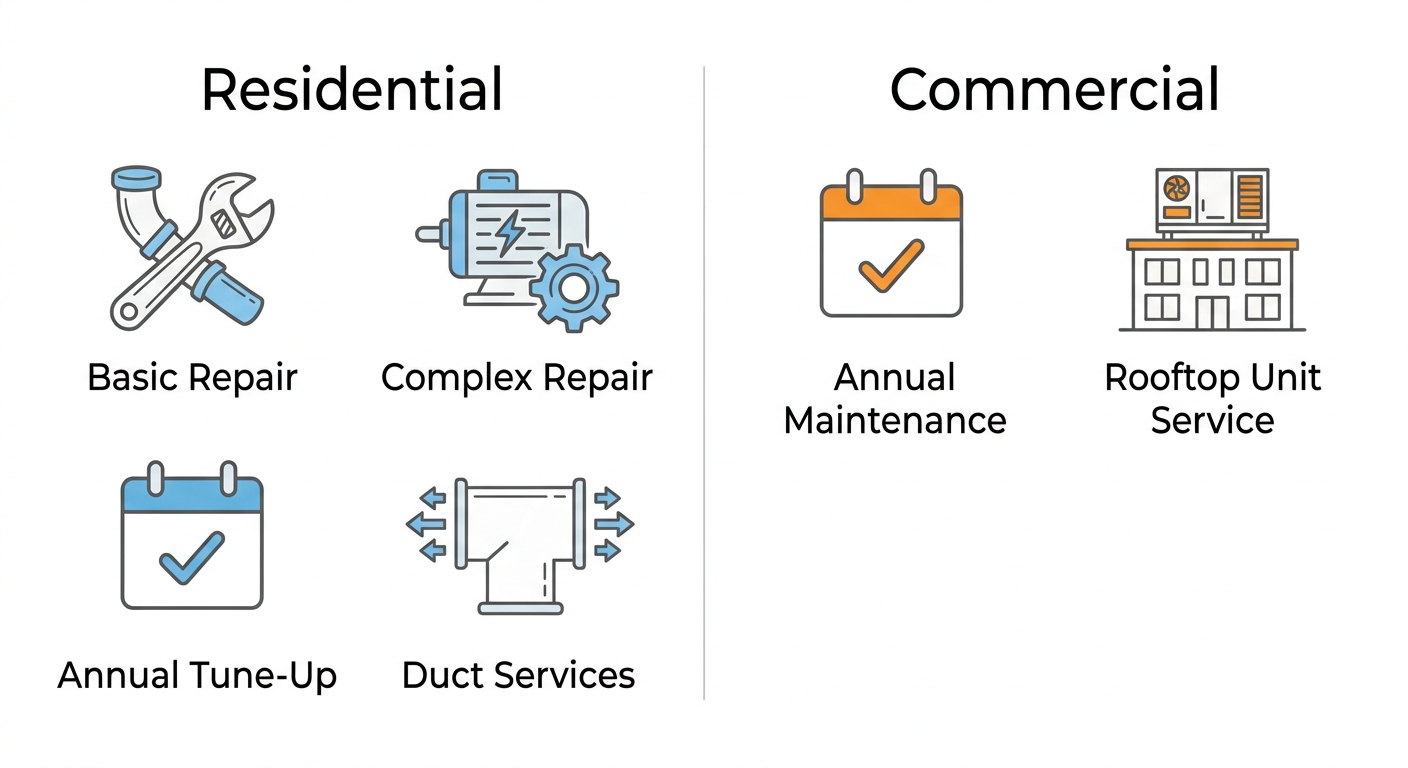
Even standard commercial repairs that appear similar in name — a leaky refrigerant line or a faulty fan motor — can take twice as long when they’re on a ten-ton RTU 30 feet above the parking lot. That’s why understanding the nature of the equipment, not just the job title, is essential when assessing any quote.
How Commercial Demand and Scale Affect Hourly Rates
Commercial jobs don’t just increase in technical difficulty — they scale up in business impact and coordination complexity. Business owners often can’t afford to shut down operations during peak hours, so commercial calls frequently happen early in the morning, late at night, or on weekends. These extended service windows mean technicians work outside standard schedules, and the hourly rate must account for that flexibility. A residential homeowner can usually schedule a one- to two-hour window any weekday, but a restaurant or retailer needs a targeted, swift repair that fits a narrow operational gap.
Specialized diagnostic equipment for larger systems — such as combustion analyzers, refrigerant leak detectors for high-pressure circuits, and recovery machines for substantial refrigerant charges — adds cost. Additionally, many commercial accounts span multiple locations, requiring our team to coordinate service across several sites, manage inventories of proprietary OEM parts, and juggle city permit requirements. These business logistics, combined with union labor agreements in certain Los Angeles facilities, can push commercial hvac labor rates per hour noticeably higher than residential rates.
Code and safety compliance further widen the gap. Commercial installations often involve stricter municipal inspections and lockout/tagout protocols that add procedure time, and the need to file and pass those inspections raises the effective hourly cost. In short, what a residential call accomplishes in an hour can stretch into a half-day commercial engagement, with all the supporting overhead that entails.
Beyond the Hourly Rate: Parts, Refrigerant, and Permits
Labor is only one line on an estimate. In both residential and commercial work, the parts, materials, and regulatory fees often outstrip the combined labor hours. Original equipment manufacturer (OEM) parts — such as control boards, compressors, and heat exchangers — come with factory pricing, and for commercial systems they can be significantly more expensive than generic replacements.
R-410A refrigerant, the standard for most modern systems, is priced per pound and sold in sealed containers to prevent cross-contamination. A large rooftop unit can hold 20 pounds or more, making a simple recharge surprisingly costly even before factoring in the technician’s time. Permit costs for gas-line work or structural modifications, along with refrigerant recovery and disposal fees, can add hundreds of dollars to a repair invoice, particularly on commercial projects. These line items are separate from the hourly rate and must be considered when comparing estimates.
With labor only a fraction of the total, the next step is to understand how we build a precise, transparent quote that accounts for all these factors — from the complexity of a rooftop unit to the permits needed for a furnace repair. Our consultation and estimate process is designed to give you an apples-to-apples comparison for your specific residential or commercial needs, a topic we’ll explore in the following section.
How Seasonal Demand Influences HVAC Labor Rates in Eagle Rock
Understanding hvac labor rates per hour in Eagle Rock means recognizing that these costs are not static figures. They fluctuate considerably, driven primarily by seasonal demand. When extreme weather hits, the pressure on local HVAC systems pushes service requests to their peak, and labor rates naturally follow. The following table provides local benchmarks for how these rates can shift based on the season and the specific service you need from a provider like Eagle Rock Prestige HVAC.
| Season / Service Type | Average Hourly Labor Rate (Eagle Rock, CA) |
|---|---|
| Peak Summer AC Emergency | $145–$210 (after-hours premiums common) |
| Winter Heater Emergency | $140–$200 |
| Off-Season Maintenance Tune-Up | $75–$115 (discounts for maintenance plan members) |
| Air Duct Cleaning Service | $90–$140 |
| Thermostat Upgrade/Install | $85–$125 (often part of a flat-rate install) |
Rates are local benchmarks for Eagle Rock, CA and vary by system age, job complexity, and provider. Contact Eagle Rock Prestige HVAC for a current quote.
This variance is a direct reflection of the basic economics of supply and demand on a local scale. During a heat wave, the demand for immediate relief skyrockets. The predictable scheduling of a tune-up disappears, and technicians are dispatched on a priority basis, often outside of standard business hours. This premium for speed and urgency is what distinguishes an emergency repair bill from a planned maintenance visit. These benchmarks illustrate the market forces at play in Eagle Rock, CA 90041, helping you budget for both expected and unexpected HVAC needs.
Seasonal Rate Fluctuations: Summer Rush vs. Winter Tune-Ups
In Eagle Rock, the contrast between summer and winter service calls highlights how seasonal demand shapes your final bill. During a summer rush, a sudden heat wave will push peak summer AC emergency hourly labor rates into the $145–$210 range. This premium reflects not just the repair itself but the cost of immediate, often after-hours dispatch when demand overwhelms normal scheduling. The intense strain on cooling systems in Eagle Rock creates a seller’s market where speed is the priority.
Conversely, winter heater emergencies, while equally urgent for homeowners, command a similar but slightly lower benchmark of $140–$200 per hour. A sudden cold snap will push heating calls to the front of the dispatch queue, carrying the same urgency-based premium. This stands in stark contrast to an off-season maintenance tune-up, which is priced between $75 and $115 per hour. The predictability of this work allows for efficient scheduling and steady labor utilization, savings that a provider like Eagle Rock Prestige HVAC can pass on through standard rates and maintenance plan member discounts.
Emergency Repairs vs. Planned Maintenance Costs
Comparing an emergency AC failure on a sweltering Sunday against a scheduled seasonal tune-up reveals a clear financial benefit to proactive planning. A Sunday call involves after-hours dispatch, extended diagnostic time, and a parts run at premium rates, easily pushing the labor costs per hour into the higher end of the $145–$210 benchmark. The total per-call cost balloons due to minimum service charges and the complexity of a rushed repair, a scenario that Eagle Rock Prestige HVAC’s 24-hour emergency service is built to handle.
In contrast, a planned maintenance visit is a predictable, efficient expense. The same system can be serviced for a per-hour benchmark of $75–$115. The job is faster, scheduled during regular hours, and allows a technician to proactively resolve issues before they fail. This fundamental difference makes the case for maintenance plans, which lock in these lower rates and provide a structured defense against the high cost of reactive, emergency calls. The value is not just in the lower per-hour rate but in avoiding the premium of a crisis-driven dispatch.
Ancillary Services: Duct Cleaning, Thermostats, and Other Add-Ons
Add-on services like air duct cleaning and thermostat upgrades introduce a separate layer to your labor costs. An air duct cleaning service, which adds significant time to a visit, is benchmarked at an average hourly labor rate of $90–$140 in Eagle Rock. It’s important to confirm whether this is billed at its own distinct hourly rate or a blended rate if part of a larger package, as it is often a separate line item from a standard tune-up.
A thermostat upgrade or install is frequently quoted differently, with a benchmark of $85–$125. To protect customers from surprise time overruns, this work is often presented as a flat-rate install rather than a pure hourly billing. When evaluating any bundled quote, you should verify whether an add-on like evaporative cooler maintenance—a relevant service given our dry climate—is being charged at its own rate or is included in the combined service fee. Always confirm the cost breakdown between labor and parts before approving work. All these figures are local estimates that vary by system complexity and provider; requesting a current quote from Eagle Rock Prestige HVAC is the best way to get a precise assessment for your home.
Long-Term Value: Why Cheapest Isn’t Always Best for HVAC Repairs
When homeowners start comparing hvac labor rates per hour, the instinct to reach for the lowest number is understandable. In Eagle Rock, per-hour HVAC pricing looks like a quick apples-to-apples metric — a $60-per-hour repair seems cheaper than a $120-per-hour service, and the immediate math feels like a win. But that narrow focus on hourly rates for HVAC work misses the deeper question: what does that labor rate actually include, and what risks does it leave behind?
A cut-rate repair that saves $40 on labor costs per hour often introduces hidden expenses that compound over time. When a fix is performed by someone pushing a minimum-price service without proper documentation, minor misdiagnoses or skipped steps lead to repeat breakdowns. A second service call — potentially at emergency pricing — quickly erases any upfront savings. The $60–$90 range in the table below typically represents a bid that excludes the overhead, licensing, and accountability that protect a homeowner’s long-term investment.
The table below illustrates why the lowest hourly rate rarely wins over the life of the repair.
| Consideration | Lowest Bid Approach | Professional HVAC Service |
|---|---|---|
| Hourly Rate | $60–$90 (often unlicensed) | $90–$150+ (fully licensed & insured) |
| Insurance & Liability | May not carry workers’ comp or liability | General liability, workers’ comp, bond — protects homeowner |
| Technician Certification | Unverified | NATE/EPA-certified, ongoing factory training |
| Warranty & Follow-Up | No written guarantee | Satisfaction guarantee, documented post-service reports |
| Energy-Efficiency Guidance | Rarely addressed | System-wide assessment, duct sealing recommendations, smart thermostat sizing |
Two rows carry the most immediate financial weight for Eagle Rock homeowners. The Insurance & Liability gap means that if an uninsured worker is injured on your property, you could be the one responsible for medical costs and lost wages — a burden that a properly licensed professional absorbs on your behalf. The Warranty & Follow-Up row exposes the difference between a handshake and a written commitment: a satisfaction guarantee and a documented post-service report give you a verifiable record of the work performed, which is especially valuable if a follow-up issue arises.
Behind those differences sits Technician Certification. Unverified labor offers no assurances about diagnostic accuracy, while NATE and EPA-certified professionals complete ongoing factory training. That translates directly to a fix that is right the first time, reducing the chance of a cascade of subsequent repairs. On the energy-efficiency side, the professional approach extends beyond the immediate fix. A system-wide assessment, targeted duct sealing, and smart thermostat sizing recommendations turn a single service visit into a recurring financial benefit — lower monthly utility bills that compound over the life of the system.
For Eagle Rock homeowners, the cost of an unreliable repair peaks in the region’s hot summers. An air conditioning failure during a July heat wave is not just uncomfortable — it risks food spoilage, disrupts sleep, and forces an emergency-call premium. A rushed, cheap repair that fails at that moment costs far more than the hourly rate seemed to promise. Which is why a professional inspection, backed by clear documentation and a satisfaction commitment, matters more than what you pay per hour for HVAC service. A thorough assessment hedges against repeated call-outs and turns a short-term expense into long-term reliability — and that is the real math behind value.
Common Questions About HVAC Labor Rates
A common question we hear in Eagle Rock is about HVAC labor rates per hour and how they affect service bills. Labor charges for HVAC work depend on repair complexity, diagnosis time, and the equipment involved. Labor is separate from parts, so the final bill reflects the actual work needed. Rather than a fixed hourly schedule, each job is priced according to what it takes to get your system running safely. Your estimate is based on a technician’s evaluation, not a generic price sheet. Labor charges also consider local market conditions—HVAC labor rates per hour in Eagle Rock reflect the cost of doing business in Los Angeles. We serve Eagle Rock and nearby neighborhoods, so our guidance is tailored to the community. For clear, upfront numbers for your specific situation, reach out to Eagle Rock Prestige HVAC for a no-obligation consultation and transparent estimate.
Planning Your HVAC Budget with Confidence
A clear budget starts by grouping your project into three main categories: equipment, labor, and necessary duct or electrical modifications. In Eagle Rock, local market conditions influence hvac labor rates per hour, reflecting the advanced skill required to install or repair modern heating and cooling systems correctly.
Always request an itemized written estimate from a licensed local professional and set aside a small contingency buffer for unexpected discoveries like worn ductwork or outdated wiring. Financing plans, routine maintenance visits, and high-efficiency equipment help balance upfront planning with sustainable long-term value. For a personalized breakdown, reach out to Eagle Rock Prestige HVAC for a straightforward assessment of your home’s needs.