
Table of Contents
Heat Pump vs Gas Furnace in California 2026: A Homeowner’s Guide
For Southern California residents considering heat pump versus gas furnace options in 2026, most homeowners could see a decrease in annual heating costs with a heat pump vs. a gas furnace. With gas prices in Southern California continuing to increase, homeowners are rethinking their heating systems.
According to ServiceMag’s local guide, heat pumps are capable of achieving a coefficient of performance (COP) of 3.0 to 3.5 during Southern California’s milder nights, outperforming gas furnace efficiencies of 80-96%.
Federal tax credits under Section 25C ended at the end of 2025, and California’s HEEHRA program has reached full funding status as of February 2026, so homeowners should check other available programs.
Nationally, the decision depends heavily on local utility rates and climate, as The Energy Collective’s analysis confirms. We’ve compiled this guide to help Eagle Rock homeowners weigh costs, efficiency, and incentives: lower energy bills when you switch to a heat pump.
Key Takeaways
- Switching to a heat pump can lower monthly energy bills for many Southern California homeowners, a fact we confirm regularly at Eagle Rock Prestige HVAC.
- The decision to move from a gas furnace to an electric heat pump unlocks benefits that go beyond monthly utility reductions.
- Los Angeles winters are mild, and people from Eagle Rock are concerned about heat pumps not working on cooler days.
- Heating with a heat pump becomes less efficient below freezing, but a dual fuel system automatically engages a gas furnace as a backup, letting homeowners capture savings during the milder months.
- Beyond the operational savings of a hybrid setup, financial incentives can further offset the initial cost of a full electric conversion.
1. Lower Energy Bills with a Heat Pump
Switching to a heat pump can lower monthly energy bills for many Southern California homeowners, a fact we confirm regularly at Eagle Rock Prestige HVAC. According to a guide by ServiceMag, heat pumps in our region can achieve a coefficient of performance (COP) of 3.0 to 3.5 during cool nights, meaning they produce three or more units of heat for every unit of electricity consumed. That efficiency advantage makes evaluating heat pump vs gas furnace efficiency a key step when upgrading your heating system.
An independent analysis by GetEveryHour explains that operating costs in PG&E territory depend on your rate plan and baseline allowance. For context, delivering 100,000 Btu using a 95% efficient gas furnace costs about $2.55 to $3.08, while a heat pump at a COP of 3.0 falls in a similar $2.74 to $3.13 range. However, replacing an older 80% AFUE furnace with a heat pump typically saves money because the higher efficiency offsets the electric rate.
A heat pump also provides air conditioning. The guide highlights this dual functionality, eliminating the need for a separate A/C unit and reducing equipment and installation costs. Note that California’s HEEHRA single-family rebate program reached full reservation on February 24, 2026, so new rebate funds are not currently available for income-qualified households. The combined heating and cooling savings make it a smart upgrade for many homes.
2. Reasons to Transition from Gas to Electric
The decision to move from a gas furnace to an electric heat pump unlocks benefits that go beyond monthly utility reductions. Modern systems achieve a coefficient of performance (COP) of 3.0 to 3.5 in moderate Southern California temperatures, meaning they deliver three or more units of heat for every unit of electricity consumed. That performance far surpasses the 80–96 percent efficiency ceiling of even the best gas units.
A system can handle both winter heating and summer cooling, thereby eliminating the need for a separate furnace and air conditioner. We simplify home comfort and reduce the number of components that require maintenance.
High-efficiency heat pumps produce 70 pounds of carbon dioxide per million Btu, compared to 123 pounds for a 95 percent efficient gas furnace. That difference supports cleaner air and meaningful environmental progress across the region.
Recent trends support the shift to more heat pump installs and less gas furnace installs. During the last few years, more heat pump units have been sold than gas furnaces sold in the U.S. This change in consumer behavior supports the shift away from gas units.
Federal Section 25C tax credits expired at the end of 2025 and California’s HEEHRA rebate program reached statewide reservation capacity in early 2026; those incentives are no longer available, but the underlying performance case remains compelling.
Today’s cold-climate designs also maintain reliable output during cooler nights, so a well-specified unit can handle seasonal dips without auxiliary backup in most parts of our region.
3. Cold-Weather Performance in Los Angeles
Los Angeles winters are mild, and people from Eagle Rock are concerned about heat pumps not working on cooler days. Data has shown that heat pumps perform well on cool days.
Industry research confirms that on typical Southern California winter nights (around 45°F), modern heat pumps achieve a coefficient of performance of 3.0 to 3.5. That translates to producing three to three and a half times as much heat as the electricity they consume—an efficiency level that no gas furnace can match. Even in inland areas where overnight lows can dip a bit further, today’s air-source units continue to deliver steady comfort.
We have the same findings from our other clients. Zero-emission heat pump systems are 300 to 400% efficient because they transfer thermal energy from the outdoors into the home rather than creating it by combustion. Because they don’t burn natural gas to create heat, they eliminate the inherent waste of burning natural gas and keep your house comfortable without the hot-and-cold swings some people associate with older heating technology.
To be reliable in cold weather, proper sizing is everything. We perform a Manual J load calculation that factors in square footage, windows, and insulation, preventing short cycling and ensuring steady warmth through Los Angeles’ coolest mornings. For an extra layer of backup, a hybrid system adds reassurance while still lowering energy bills.
4. Hybrid HVAC System Savings Potential
Heating with a heat pump becomes less efficient below freezing, but a dual fuel system automatically engages a gas furnace as a backup, letting homeowners capture savings during the milder months.
Data from Servicemag.org shows that providing 100,000 Btu of heat with a 95% efficient gas furnace costs approximately $2.55 to $3.08. A heat pump operating at a COP of 3.0-3.5 provides a better value when ambient temperatures are above 45° F. During nights when temperatures dip into the 30’s, heat pump efficiency begins to decrease and a gas furnace is a better option to provide cost-effective heat.
Homeowners should also be aware that major financial incentives are no longer available in 2026. The federal Energy Efficient Home Improvement Credit (Section 25C) expires December 31, 2025. The California HEEHRA single-family rebate program reached its maximum fund limit February 24, 2026.
Ultimately, expected savings will vary based on a number of factors including how the equipment is sized, how it is used and the rate plan selected. For these reasons, a professional load calculation is essential, and we encourage Eagle Rock homeowners to contact our team for a personalized assessment that evaluates how a dual-fuel or all-electric system could perform in their specific home. The potential savings from a dual-fuel system should also be weighed against the potential savings from converting to an all-electric system.
5. Incentives for Converting to All-Electric
Beyond the operational savings of a hybrid setup, financial incentives can further offset the initial cost of a full electric conversion. As of 2026, the landscape has shifted: several major programs have ended or are fully reserved, though targeted support still exists in California for qualifying homeowners.
The federal 25C tax credit for energy-efficient home improvements expired on December 31, 2025. According to the California Energy Commission, this credit is no longer available for projects completed in 2026. The TECH Clean California program for single-family HVAC and water heating incentives permanently closed on November 14, 2025 with no Phase II planned, removing another previously popular option.
California’s HEEHRA single-family rebates—which offered up to $8,000 for income-qualified households at or below 80% AMI—reached full reservation on February 24, 2026. The state maintains an active waitlist, and multi-family rebates up to $14,000 per unit remain available through the program. Meanwhile, the HOMES whole-home rebate program, allocated $291 million for California, had not launched as of October 2026.
Rebate claim windows typically remain open for 12 months from the date of equipment purchase. We recommend verifying eligibility with your utility and using contractors familiar with documentation requirements.
Keep these incentives in mind as you weigh the upfront costs and long-term benefits of a heat pump versus a gas furnace.
6. Choosing Between Heat Pump and Gas Furnace
Consider other factors when calculating heat pump vs gas furnace cost in Eagle Rock.
| Factor | Heat Pump | Gas Furnace |
|---|---|---|
| Energy Efficiency (COP) | COP of 3.0 to 3.5 in moderate temperatures | Up to 95% AFUE |
| Heating & Cooling (One System) | Yes – heats and cools | No – requires separate AC |
| CO2 Emissions | Lower | Higher |
| National Shipment Trend (2020–2025) | Outpaced gas furnace | Trailing heat pump |
| Federal Tax Credit (Expired) | Section 25C expired Dec 31, 2025 | N/A |
| State HEEHRA Rebate | Up to $8,000 for income-qualified; currently waitlisted | N/A |
| Cold Weather Performance | COP ~1.9 at 0–5°F | Consistent output |
| Replacement Considerations | Replaces furnace and AC | Furnace replacement only; AC separate |
| PG&E Operating Cost (100k Btu) | Varies; generally economical with older AC replacement | $2.55–$3.08 with 95% efficiency |
According to the California Energy Commission, HEEHRA single-family rebates up to $8,000 are fully reserved by February 2026 and require TECH Clean California certified contractors.
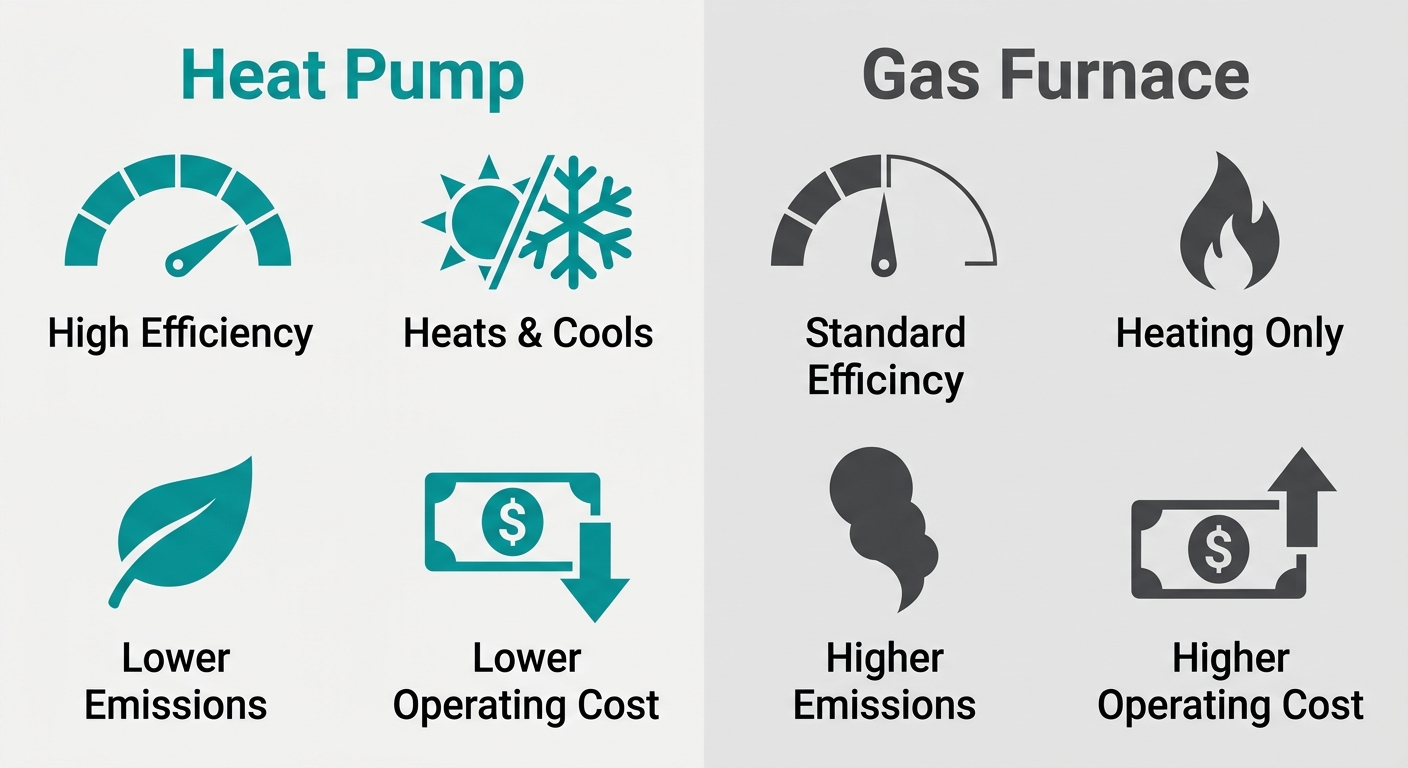
Now look at your home and decide what heating option best meets the needs of your Eagle Rock residence.
Frequently asked questions
What are the pros and cons of switching from gas to electric heating?
The pros are higher efficiency with a coefficient of performance of 3.0 to 3.5, a single system that provides both heating and cooling, and lower carbon emissions. The cons are that federal Section 25C tax credits expired at the end of 2025 and California HEEHRA rebates are fully reserved, so financial incentives are limited, and efficiency drops in freezing temperatures.
How does a heat pump perform during occasional Los Angeles cold snaps?
Heat pumps perform well during Los Angeles cold snaps. On typical winter nights around 45 degrees Fahrenheit, modern units achieve a coefficient of performance of 3.0 to 3.5, meaning they produce three or more units of heat per unit of electricity. Proper sizing with a Manual J calculation ensures steady warmth even in inland areas with slightly lower overnight lows.
Will I save money on my gas bill by installing a hybrid HVAC system?
Yes, a hybrid system can save on your gas bill because the heat pump handles heating during milder months when it is most efficient, and the gas furnace automatically engages only during colder conditions when heat pump efficiency drops. Actual savings depend on equipment sizing, usage, and your electric rate plan.
What incentives are available for converting a home to all-electric HVAC?
As of 2026, the federal 25C tax credit expired, the TECH Clean California program closed, and HEEHRA single-family rebates are fully reserved with a waitlist. Multi-family HEEHRA rebates up to $14,000 per unit remain available. Utility-specific rebates may still be offered with claim windows typically open for 12 months after equipment purchase.
Choosing Your Best Heating Option for Eagle Rock
With the differences between heat pumps and gas furnaces clear, the heat pump vs gas furnace decision in California for 2026 comes down to your Eagle Rock home’s needs and priorities. One analysis notes heat pumps can achieve a COP of 3.0 to 3.5 in Southern California, with estimated annual heating costs of $300–$640 versus $540–$1,100 for gas furnaces. The Energy Collective found the cost to generate a million Btu from a gas furnace rose 52.7% from 2016 to 2025, versus a 37.9% rise for best-available heat pumps. Federal 25C tax credits expired at the end of 2025, and the California Energy Commission reports HEEHRA single-family rebates were fully reserved as of February 2026; income-qualified households under 80% AMI may still explore multi-family or waitlist options through TECH-certified contractors.
Contact Eagle Rock Prestige HVAC. We can evaluate your home’s layout and existing equipment. Review our privacy policy. All third-party trademarks remain the property of their respective owners.
Get Personalized HVAC Advice
Now that you’ve explored the efficiency, cost, and incentive comparisons between heat pumps and gas furnaces for California in 2026, you have a solid foundation for making your decision. Heat pumps offer impressive efficiency with a COP of 3.0 to 3.5 in moderate temperatures, but your specific PG&E rate plan and home setup can significantly influence savings. With federal tax credits expired and HEEHRA rebates fully reserved, individual guidance is more valuable than ever. Our licensed technicians provide expert consultations tailored to your Eagle Rock home’s heating and cooling needs. You can reach us at (818) 732-8552 or visit our contact page to schedule an appointment. Let us help you determine whether a heat pump, gas furnace, or hybrid system is the most cost-effective choice for your situation. Your ideal home comfort solution is just a call away.
Resources
- Find California HEEHRA Energy Rebates for 2026
- Navigate 2026 Heat Pump Incentive Programs in California
- Discover Heat Pump Advantages for Southern California
- Compare Heat Pump vs Gas Furnace Costs for PG&E
- Get 2026 California Residential Energy Rebate Status
- Discover National Heat Pump vs Gas Furnace Trends